In 2022, I volunteered with a campaign to unseat my district’s representative on the Travis County Commissioners Court. Brigid Shea had been serving mostly satisfactorily for ten years, but there were some issues that she pushed that greatly disturbed me, notably an attempt to open a new jail and giving tax breaks for Tesla to build a factory in Austin. We went door to door with flyers, telling our neighbors why Bob, our candidate, was a better choice than Shea. We told them how Shea voted to let Tesla move here, but at the time, it wasn’t a convincing argument. “Why is it bad that Tesla is moving here? They make electric cars.” They are a terrible company, we explained, and Musk was a terrible man who, once he had economic and political leverage in our community, would ruin it. “But doesn’t it create jobs?” Yes, but they are bad jobs; Tesla has a history of treating workers poorly. We ultimately didn’t convince voters that these things mattered enough to overcome the incumbent advantage, and she still represents me.
I maintain a grudge against Shea about Tesla, but I am sure that she now regrets her vote as well since she’s staunchly anti-Trump. I am not sure that she regretted it before 2025, when Musk was funding conservative political campaigns in Austin that would benefit wealthy homeowners, even if they were Democrats. While I can hold a grudge against the politicians who should have done deeper research before voting, I don’t hold a grudge against the voters. Talking to them, we learned that what was obvious to us, that Musk and Tesla would actively make Austin worse, was not obvious to the public. It’s not limited to Austin; Etsy sellers are making good money selling bumper stickers for Teslas to help the owners demonstrate that they did not know where their money was going. It’s led me to wonder: how did we know? How was it that those of us in DSA supporting Bob’s campaign were so sure but our neighbors weren’t?
I have been a Musk hater for as long as I can remember knowing about his existence, but I don’t know what triggered it. I remember reading Seveneves, a popular science fiction novel published in 2016 that features a Musk stand-in as a hero who sacrifices himself for humanity, and thinking it was the dumbest thing I ever read. Why was I so sure? I want to know not so I can say, “I told you so,” but because I want to know what it would take to make villainy more obvious; I want to know how to prevent the next Musk.
I know that I pay attention to more news than the average person. I certainly follow more labor news, so I would have noticed and paid attention to the Tesla and SpaceX workplace safety and harassment stories. I paid attention to the destruction of Boca Chica because it was here in Texas. I also read tech news, but I don’t think that helped here because the tech reporters were so credulous. As a software engineer, though, I had the domain knowledge to know that Musk knew nothing about the domain himself. Similarly, as a socialist, I brought a class analysis to the news about Tesla and Musk that I’ve read throughout the decade. When I see Musk make an off hand remark about union busting, I instantly know that he was not some kind of “visionary” but that he’s relied on poor treatment of labor for profit like every other capitalist. The mere fact that he’s a billionaire is enough to earn my distrust, because billionaires shouldn’t exist. (Sorry, Rihanna.)
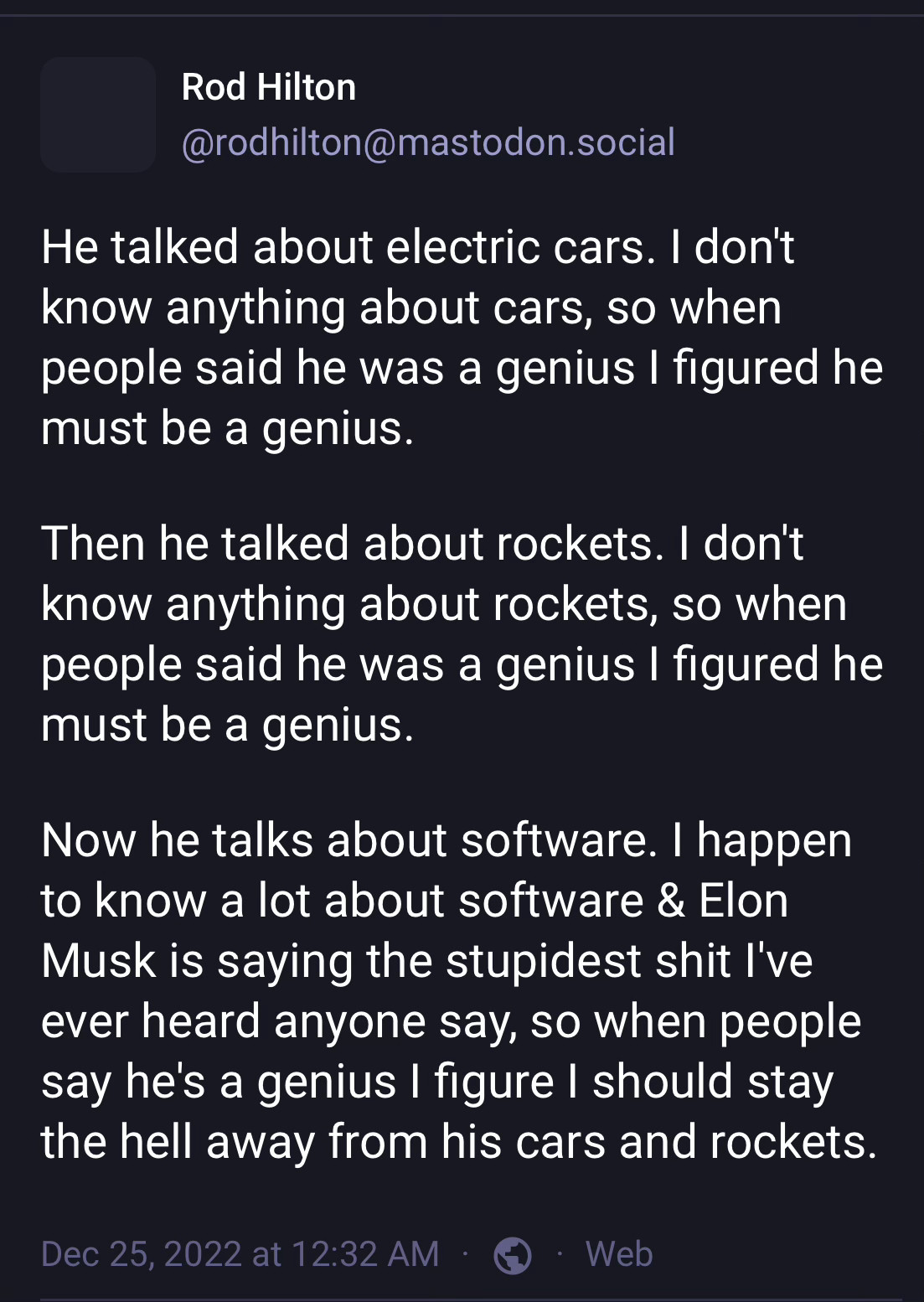
Closer attention to tech, labor, and environmental news may explain a greater awareness, but I have trouble proving this satisfactorily. Our information ecosystem has degraded so it’s difficult to find what articles I would have read years ago that made me skeptical. I have personally published an article online about Musk, but when I tried to find it today to see what year I wrote it, I can’t. It’s gone. Worse, it’s likely that many of my sources were not articles at all but tweets. As a fan of Grimes’ music, I followed her on Twitter and I remember watching in real time as she responded to allegations about union busting in Tesla factories. She later deleted the tweets. In this case, I was able to find a recap because some journalist thought it worthy of capturing at the time. A more recent example of the danger of politics being made on social media is the exposure of Geoff Garin. A single sentence in an article about Harris’ campaign alerted the public to the fact that 72-years-old Democratic operative Garin suggested to Harris and Walz that they stop the “weird” messaging that was seemingly so successful during Brat Summer. Garin joined BlueSky right then, and hecklers tried to run him off. In the course of trying to defend his choices, he inadvertently revealed more about the cluelessness of the Democratic establishment. I recently tried to track down this exchange again and, not being able to remember Garin’s name, I was only able to do it because I am personally friends with the prime heckler. I took screenshots in case anyone deletes their accounts or BlueSky is censored by our fascist state.
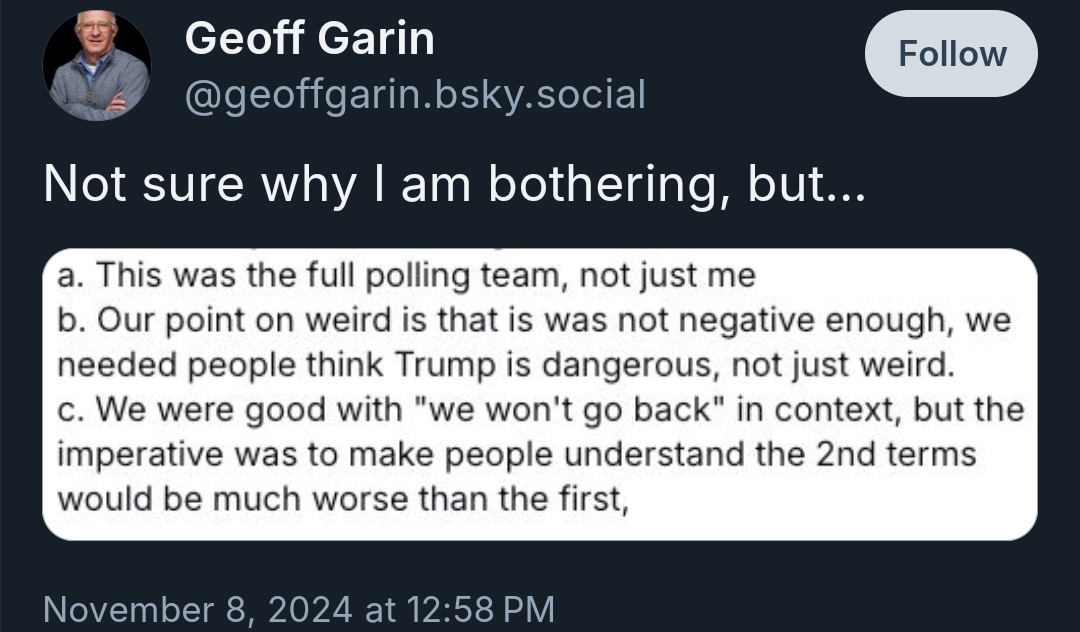
Is this how we are supposed to keep receipts? Hoping that individuals take screenshots of every skeet they see? How do we build the case that these powerful men are ongoing menaces? In Austin, the next time Kind bar CEO Daniel Lubetzky signals his support for a political candidate, how do I get voters to know that’s a red flag for that candidate because Lubetzky is as politically vile as Musk but more insidious? How do we do it when journalists are unpaid, stories are censored, enshittification has ruined search, and no one uses text-based media? My experience suggests that one route is to build class consciousness so that the average person is less swayed by cars being shot into space, but we’ve been attempting that since 1848. That doesn’t mean that I am going to stop trying, but damn, it’s hard.
 Libromancy