What I’ve been reading

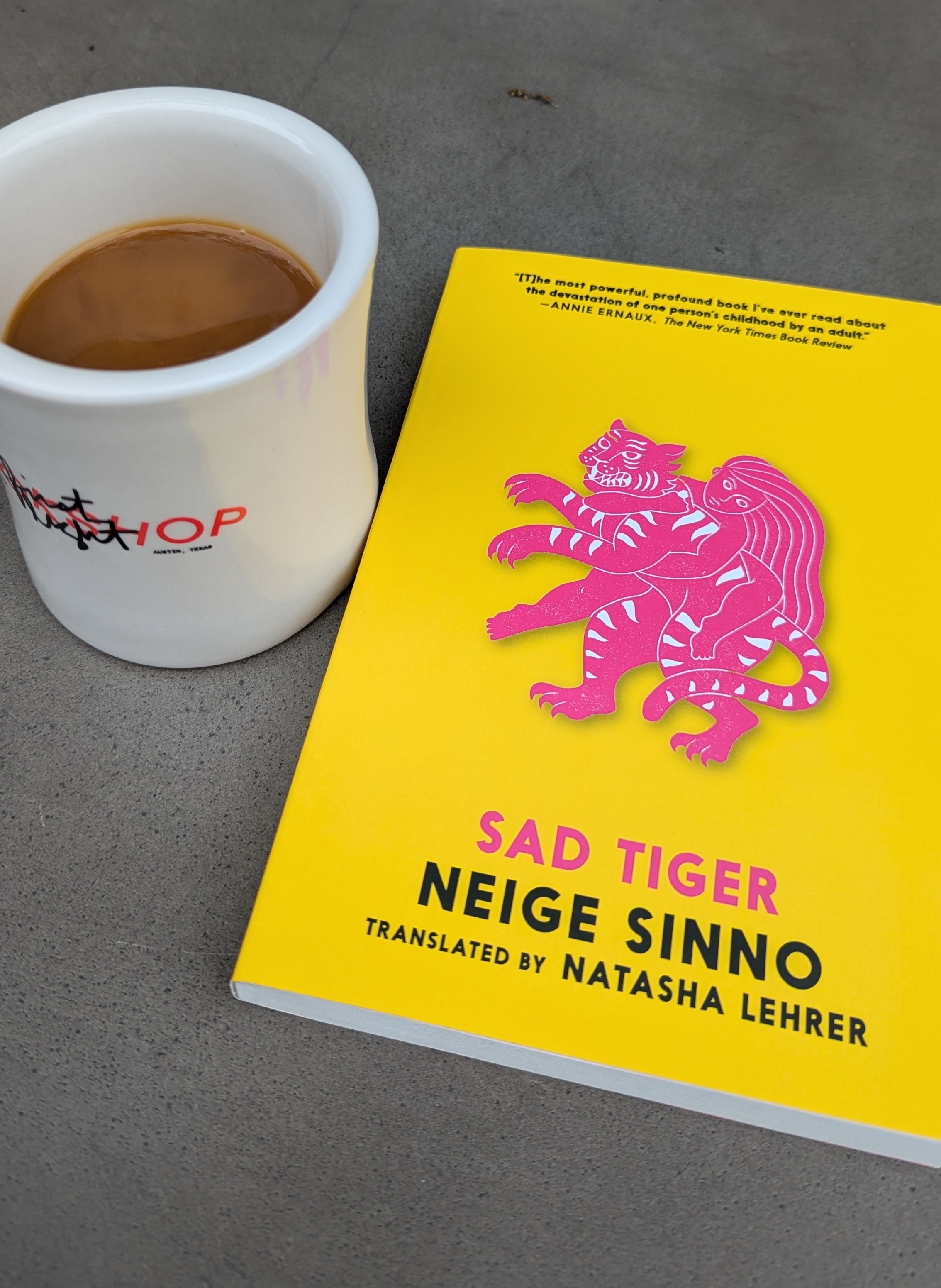
The book Sad Tiger and a cup of coffee

(Despite the photo, I have NOT been reading Sad Tiger. I picked up my pre-order and saw it described as “devastating” and was not ready for it.)

First Love by Ivan Turgenev, translated by Isaiah Berlin

The Mookse and Gripes podcast has started a novella book club, and this is the first selection. It’s an experiment in using Discord to collect former book twitter folks into a reading group. It’s also an experiment, for me, in slowly reading a novella. This could be read in one sitting but instead it’s being spread out over a week. I read the first third and had to pause myself from reading further.

Notebooks by Tom Cox

I haven’t had time lately because my mornings are now used for exercise, but I used to have a “morning book” that I read a little bit of every day before writing in my journal. It was usually diaries or something similar, and I would spend a bit time examining how other people process their lives before processing mine. Notebooks sort of fits that theme. It’s excerpts from Cox’s notebooks, so it’s real like a diary but the excerpts are more like tweets. They are short quips, with an occasional longer bit that might take up a whole two paragraphs. It’s hard to read in long chunks for the same reason it would be hard to sit down and read someone’s twitter feed all the way through. Each individual bit, however, is a delight with hilarious stories about mischievous Devon hedgehogs and the antics of his dad WHO TALKS LIKE THIS.

Strike! by Jeremy Brecher

Ok, I haven’t really started this one yet. My local DSA chapter is about to start reading this history of American strikes alongside The Troublemaker’s Handbook. I am a little less enthusiastic now that Shawn Fain is out there making the labor movement look bad, but I do want to be more educated about the subject for the next time I get into an argument about “why don’t Americans call a general strike?” I might not actually manage to read my assigned bits before we meet, but the DSA bookclubs are the sort where the discussion the books prompt about current conditions is the vital part.

Butter by Asako Yuzuki, translated by Polly Barton

This is the book that I’m actually reading in the sense that I carry it around with me everywhere and dip in as time allows. I picked it up on a whim at the bookstore when I saw Barton’s name and the cover blurb. Rika is a young female journalist at a publication that has never had a woman writer. She works long hours to become the first, neglecting her own love life and comforts, eating only 7/11 onigiri and grab-and-go salads. In an attempt to get an exclusive interview with a former food blogger, Kajii, accused of murdering men she met on dating apps, Rika starts to follow Kajii’s orders about what to eat and cook. From prison, Kajii gives Rika assignments such as to bake a quatre-quarts and serve it to a man while it is still hot from the oven. Rika begins to embrace the sensuality of food in a way she hadn’t before, but also gains weight, forcing her to confront the extreme fatphobia and misogyny of Japan. The ways the case transforms her life aren’t straightforward, and about two-thirds of the way through, this novel takes a different direction which pleasantly surprised me after I had been lulled into a routine of jailhouse interviews and baking. I still have at least a hundred pages to go, but I feel like I am in good hands with Yuzuki and Barton.
First Page: Days of Abandoment

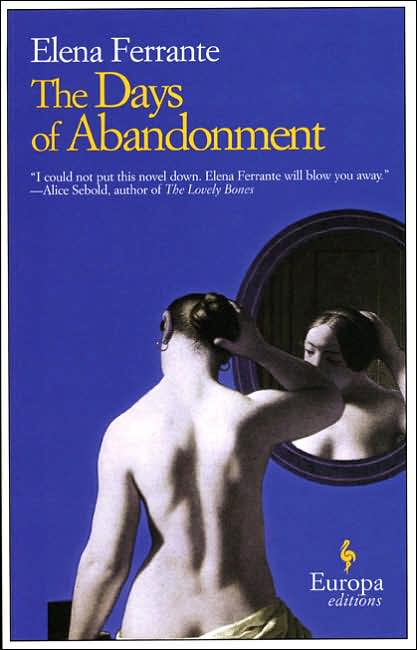
Book cover showing a nude woman looking at herself in a mirror


A few months ago, I had a post where I talked about two books I had barely began to read at the time, The Blue Book and A Tale for the Time Being.  Thanks to ‘samples’ in ebook stores, I’ve more than ever been judging a book by its first few chapters, deciding if I want to purchase it or, more importantly, continue reading it.

Last night, unable to sleep because of my continuing cough, I downloaded the sample of Elena Ferrante’s Days of Abandonment and began to read. I’ve never read any Ferrante, and by the end of that first, fairly short chapter I decided that I was going to binge read as many of her works as I could.

The writing is the sort that seems unaffected, with no obvious literary frills, as if the narrator is just using the most expedient means to telling her story. This is an illusion that takes great skill. She maintains the aura of reality even while taking writerly detours, like describing the view from the balcony of their new home, something unlikely to come up in an everyday recitation of events.

And I truly do buy into the reality. Halfway through chapter one, I realized my brain is thinking that this narrator is Elena, that she’s only reminding me of her husband Mario’s name because I already know him. I often forget fictional characters aren’t real, but usually this happens with television shows where I have spent years in their lives. Here I’m a few paragraphs in and my delusions are already settling in.

Today I stopped at the library and picked up Days of Abandonment, My Brilliant Friend, and then bought The Story of a New Name. As I was checking out at the library, the clerk smiled as if she had a secret, then said quietly, “You’ve found some good books.” I hope that I have.


Bedtime reading

I have barely had any time for reading lately. I checked out a handful of books from the library months ago and some are still unread. They are due back this month, so a week ago I decided that I HAD to read them, and I finally dived into one: Mo Yan’s Sandlewood Death.

Soldier firing  a rifle

I wish I had started it sooner. It’s a fine book to read when you don’t have time. I’ve been averaging about 5 pages a night, but this book is so rich that in those five pages I usually have already marveled at some myth or experienced a trauma. There is no exposition that doesn’t link back into the greater themes that Mo Yan is attempting to touch on. There is no scene that doesn’t cause me to laugh or grimace.

I am enjoying this book so much that I am actually reading even less than I would given my time constraints. I always alight upon a sentence that’s too exquisite to read once. I have to backtrack and read it aloud to my boyfriend. This usually leads to confusion on his part–“Wait, why is there a beard contest?”–and then I have to backtrack and retell the story in my own words. He’s come to look forward to updates on the lives of Sun Bing and Magistrate Qian and Sun Meiniang. I certainly didn’t expect to get this sort of pleasure out of what appears to be a rather grim tome (the plot conerns painful forms of torture), yet my boyfriend and I are reacting to it with the same enthusiasm that we usually reserve for our latest Netflix binge du jour.

(As an aside, Sandalwood Death is on my list of predictions for the 2014 Best Translated Book Award.)

A Tale of Two Openings

I’ve been trying to read The Blue Book by A. L. Kennedy, but I’m having trouble working up any enthusiasm for the book. If I could pinpoint the reason, I might feel validated in giving it up, but instead I keep forcing myself to bring it to work with me in case I might feel like reading it during lunch. Finally a friend convinced me that I should not be so slavishly loyal that I don’t read at all, so I picked up some books on a whim and have been alternating between them and The Blue Book. I sped through two mystery novels this way, then started Ruth Ozeki’s A Tale for the Time Being.

As soon as I opened A Tale for the Time Being (henceforth, ATftTB), I noticed an eerie coincidence. Both ATftTB and The Blue Book begin in the second person. Seeing the word ‘you’ on a page, absent of dialogue, is a strange enough feeling, but to have both of the novels that I’m reading shock me with that word?

Even though both openings have that particular structural similarity, they are otherwise quite different, at least in how I reacted to them. The Blue Book‘s usage of ‘you’ irritated me a bit, while ATftTB drew me in. What was the difference? Even after rereading the first page of each over and again, I am still unsure.

The Blue Book begins:

But here this is, the book you’re reading.

Obviously.

Although I have no describable reason for assuming this, it strikes me as a literary affectation. The book that tells me about the book that I am reading. Except I have a hunch that this book will not be If on a Winter’s Night, a Traveler

Kennedy goes on to describe how I am approaching the book. “…you face it.” So far, yes, I am facing it. Then, “you are so close here that if it were a person you might kiss. That might be unavoidable.” Certainly if a person’s face were nuzzled into my lap as this book is, I would hope they would be someone I would feel comfortable kissing. “You can remember times when kissing has been unavoidable.” Can I? Not really. And even if I could, I certainly wasn’t remembering them until the narrator mentioned it.

This is Kennedy’s tactic; to attempt to put thoughts in my head. It kind of works, in the way not thinking of a pink elephant works. The problem is, I’m not clear why yet I’m being addressed this way, and if it has a point beyond affectation. I am still cautious, suspicious. I have not yet given Kennedy my trust. And here she is, trying to infiltrate my thoughts.

I agree that I did sign up for that when I picked up the novel; such infiltration is the entire purpose of literature. I guess maybe I am just used to books being a bit more circumspect. I would like to get to know someone, after all, before they nuzzle their face into my lap.

ATftTB begins:

Hi!

My name is Nao, and I am a time being. Do you know what a time being is? Well, if you give me a moment, I will tell you.

This book introduced itself, or rather one of its narrators did. I already feel more comfortable with it. Then Nao launches into what a time being is, as promised. Like Kennedy, Ozeki is using a meta book within a book, and drawing attention to her technique, the kind of tricks that tend to make me mutter “MFA” under my breath and sigh. Nao, though, makes it clear to me fairly soon that the technique is not a show, her time being explanations linking the tactic to the works’ themes.

“You wonder about me,” Nao says. I am wondering about her; her observations still align with my thoughts so the fourth wall is reinforced rather than weakened. “I wonder about you.” Nao is suddenly relatable; we are sharing this activity of wondering together. The tiniest emotional connections begin to form (well, strengthen. They formed at that first exclamation point.) I pull back for just a moment before I get sucked in, just long enough to wonder, “how long can Ozeki keep up this conversation before it beings to feel false?” Nao continues, “Are you a male or a female or somewhere in between?…Do you have a cat and is she sitting on your lap? Does her forehead smell like cedar trees and fresh sweet air?”

I’m still not very far into the book, but so I can only give a noncommital answer to my question “how long will this feeling last?” At least 100 pages.