Recent Links

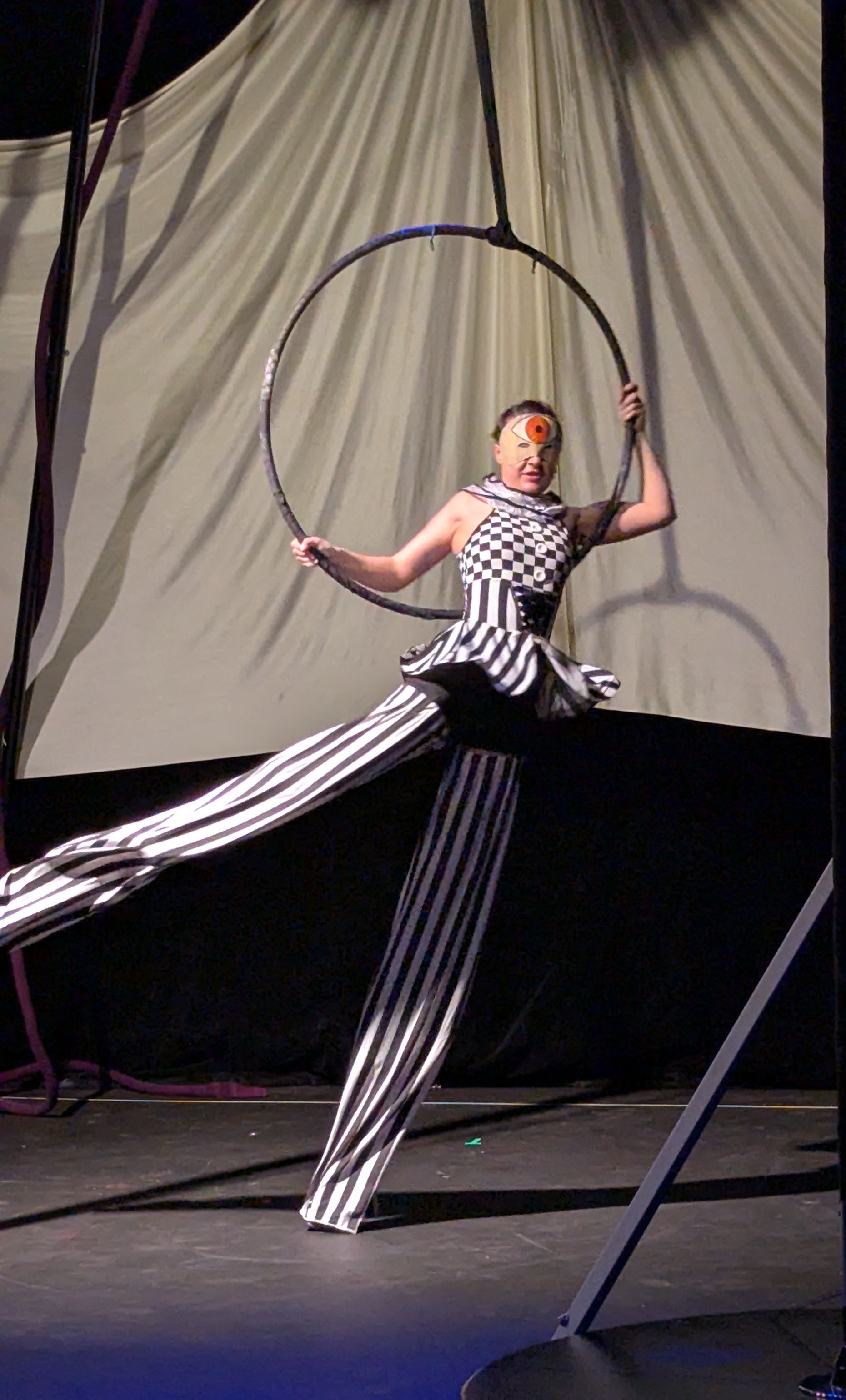
A dancer on stilts swinging around a lyar
Cyclops in Fly Unfeathered’s aerial dance adaptation of The Odyssey.

Call Me Comrade – Miriam Dobson – London Review of Books – During the Cold War, there were groups that encouraged letter writing between American housewives and Soviet women. Interesting look into the ways this changed the letter writers.

Fergus Macintosh, lead fact checker at the New Yorker, interviewed by Merve Emre – Fascinating. I thought I knew in a general sense what a fact checker did, but I didn’t realize the extent. There’s also an exercise in examining a sentence to find all the things that you think should be fact checked in it.

An exercise in creating art in the style of Bill Beckley – celine nguyen – try it yourself!

London’s Low-Traffic Zones Cut Deaths and Injuries by More than a Third – The Guardian – We have a few of these in the city, but they are all in places where traffic would already be low. The only places that drivers will allow them are places where drivers don’t go in the first place, usually neighborhood streets that are not through streets so the only traffic is from the 20 or so homes on the block. The article talks about a similar study of speed limits where it describes 20 mph as a slow, safe speed limit. If I go 17 miles per hour on my bike, someone will complain that it’s dangerous for pedestrians, but 20 in a car is perceived as “safe.”

Now available on Jstor, the digitizied diaries of the only woman, serving as a stewardess, on an 1890s steam ship.

José R. Ralat at Texas Monthly is the world’s only (known) full-time Taco Editor. One of the common questions he gets is how he does the job in Texas without driving.

5 Things Regular Drivers Might Not Know About Cyclists

  1. At stop lights, we flirt with our fellow cyclists. We compliment each other’s bikes. Or sometimes we just say “hello” or let them know their shirt is on backwards. Personally, I engage in many passive aggressive undeclared races with cyclists who are rude. The point is that we are sometimes interacting directly with other cyclists, as part of a community. We are not isolated from one another, or from the consequences of our behavior. (But seriously, more people flirt with me when I am on my bike than at any other time in my day.)
  2. We can feel the paint on the road. We are sensitive to road conditions like debris that a driver wouldn’t even be conscious of. If you wonder why a cyclist is in the car lane instead of what appears to be a perfectly good bike lane, it’s likely because there are dangers in the bike lane that aren’t apparent to drivers. For instance, a pile of leaves can conceal dangerous glass or holes, so it’s best to avoid them altogether.
  3. We see a lot of broken glass and car parts at intersections. We see curbs that have been destroyed by vehicles that don’t stay in their lanes. We see more of the effects and frequency of poor driving than drivers do.
  4. We are not expected to follow the law (by traffic engineers). A cyclist has trouble following traffic law 100% of the time because, for cyclists, those laws are poorly-defined and in flux. For instance, on my morning commute there is a light that triggers when cars pull up to it. It doesn’t trigger for my bike. I have to run the red light if no car shows up to save me. Engineers have considered this when installing the light and decided it was ok. There are areas of town where according to the city, cyclists are not allowed to ride on the sidewalk. Some parts of this area also have road paint indicating that cyclists should ride on the sidewalk for a block and then abruptly hop back onto the bike lane. Sometimes the bike lane suddenly switches to being on the left side of the road, and I have to merge across three lanes and ride on the left before having to merge back right and ride on the right. Sometimes safety takes priority over either indicators or laws. It’s safer for pedestrians and cyclists to cross a street slightly before the light turns green for drivers. Many intersections will flash the walk sign for pedestrians a few seconds before the light turns green. As a cyclist, do I wait for the light to turn green or do I cross with pedestrians? Do I follow written laws, or do I follow the road indicators installed by traffic engineers? Or in cases when neither is safe, do illegal but safer for everyone near? Cyclists constantly have to make their own decisions about when to follow the law.
  5. There are more of us than you know because we’re deliberately riding on roads where you won’t encounter us. When I first started commuting to my current office, I took the direct route. Not necessarily the one a driver would take, but still using whichever major roads had bike lanes. Over time, through experimentation and talking to other cyclists, I landed on a route that zig zags through residential neighborhoods and parking lots, selecting for quiet and well-paved paths. I see many other cyclists on this circuitous route; apparently they have discovered the same paths I did and made the same choices. The only drivers who see us on this route are homeowners along the path. Other drivers would not be aware of how many workers are commuting by bike every day because we’re deliberately hidden.