Soup’s On!


Cover of 30 Minute Vegan's Soup's On

Soup’s On by the 30-Minute Vegan–a.k.a. Mark Reinfeld–is pretty much what’s described on the tin: a variety of soup recipes all designed to be completed under thirty minutes. Soups are known for being fairly simple to make and for gaining flavor through time; here the simplicity is preserved and time saved by listing the flavor developing steps as “optional”.

The first chapter, “The Art of Soup Creation”, concerns how to make a soup, the kind of basic cooking instruction that beginning home cooks need and I wish more cookbooks provided. The usually cited foundational techniques for building flavor are skimmed over, however. Instead the focus is on using recipes as a template, explaining how to take a soup recipe, break it down into its requisite parts, then rebuild it with different ingredients. The book ends with another instructional chapter on soup finishing techniques, including recipes for garnishes like Vegan Crème FraÎche and Candied Pepitas as well as a few sides including ‘Cosmic Cornbread’ and Herbed Bread Sticks. Intervening chapters are organized by type of soup, such as “Creamy Blended Soups” and “Soups and Stews with Grains, Legumes, and Pasta”.

In addition to the recipe chapters, the book contains multiple appendices of varying usefulness. There are seasonal growing charts, but which climate zone they apply to is unknown, and the relevance of gardening in a book that implies 5 minutes can’t be spared to brown an onion is unclear. Another appendix contains a call to action against GMOs (the book is full of unsubstantiated health claims that seem out of place). More useful is a chart showing recommended soaking times of nuts and another chart showing measurement equivalencies for different natural sweeteners, allowing you to easily substitute agave nectar or brown rice syrup for sugar in any recipe. This is the kind of information that allows beginners to feel more confident in a kitchen, which seem appropriate to a book like this.

Less instructional are the recipes themselves. Everything I tried tasted delicious, especially a cauliflower soup that tasted like a velvety vegan cheese sauce. Producing that deliciousness, however, required me to make many judgement calls. Each recipe lists a few optional ingredients and cooking methods. In some cases the ‘optional’ method felt vital to me so I went with it, and I can’t be sure what the result would be for a novice following the bare bones version of each recipe. The recipe for Indian Chutney Stew with Tamarind, for instance, begins with pouring vegetable stock in a pot and then tossing in a slew of raw vegetables to boil. The main ingredient, tamarind paste, was to be one to three tablespoons. For such a pungent ingredient and the main flavor component of the dish, I would have appreciated a more specific suggestion. Meanwhile, adding a sweetener to balance the sourness of the tamarind was listed as optional. I found the soup almost inedible without this ‘optional’ ingredient. By following the ‘variations’ that involved sautéing the vegetables first, as well as adding some agave nectar, I ended with a delicious soup. The result was fantastic, but the recipe as written would not be something that I would recommend.

The target of this book appears to be inexperienced home cooks, but such cooks would be better served by learning more traditional ways of building flavor rather than how to throw things in a pot and boil them according to a recipe. If you are looking for some quick but tasty soup suggestions, I would recommend this book only in exchange for a promise to always take the 5 extra minutes to follow the optional instructions.
Site update

Hello all,

Just wanted to pop in and explain my recent lack of posts here. I’ve been busy with a side project that I’m working on–a video game that I’m coding solo, top to bottom.

In the new year, I’ll review a few cookbooks that I have my eye on. I still have to eat everyday, after all. Literature reviews will continue to be slow, though, as I don’t have the time to do the in-depth reading that I normally do for a review.

See you in the new year!

Sara

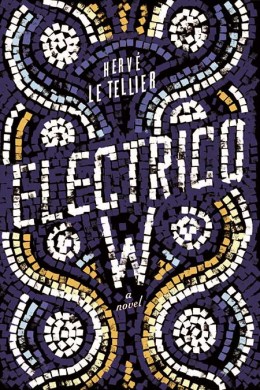
Eléctrico W

Electrcio W Cover


On Vincent Balmer’s first of nine days spent in Lisbon with his friend Antonio, they shared an olive-colored taxi to Rossio Square. Antonio was a native of Lisbon returning home for the first time after years ten traveling the world as a documentary photographer. Vincent watched Antonio look out the taxi window and light a cigarette. Vincent was struck by the tableau:

“It felt as if time had taken a step to one side, a divergence as fine as a crack in the glaze on porcelain. Something unfamiliar has insinuated itself inside me. I can think of no other way of putting it: I no longer saw a thirty-year old man in flesh and blood sitting beside me on that seat with its cracked leather, but a character, a character from a book.”

That night he sat down and described what he had seen, instantly deciding that it would be the beginning of a novel about Antonio entitled Eléctrico W.

Except that this is not the Eléctrico W that I read. The Eléctrico W that exists as a physical object in our world is a novel by French Oulipian Hervé Le Tellier and is about a writer named Vincent Balmer writing a novel. The metafictional playfulness extends a few layers deeper. In addition to writing Antonio’s story, Vincent is working on a novel about Pescheux d’Herbinville, a slighted lover known primarily for killing math prodigy Evariste Galois in a duel. The jealousy that drove Galois’ murder mirrors Vincent’s own emotional tensions provoked by Antonio’s romantic successes, leading the reader to turn pages faster to see if Vincent’s actions will also align with d’Herbinville’s. Additionally, Vincent has been translating a Portuguese Borgesian author named Jaime Montestrela. Montestrela’s works are all snippets about imaginary cultures engaging in a variety of strange but sublime religious rituals:

“When January 12 falls on a Sunday, the Picardy village of Abelvilly still to this day celebrates it as the Feast of the Gulerian, when this creature is hunted for the tender meat on its large fleshy ears. The gulerian is a patagrade with a bright orange pelt, similar to a badger in size and tortoise in mobility and agility, specific to that part of the Caux region and sadly extinct since the first Feast of the Gulerian in the year of grace 1197.”

We aren’t given to know if Le Tellier has hidden additional constraints within these stories, but Vincent thinks that Montestrela has. Each snippet is mailed to a different person on a different date, and each is dutifully recorded in his book. Are the stories secret messages passed around the world by post? More importantly, what are they communicating to us about Vincent?

Little of Le Tellier’s work has been published in English thus far, and what has been published has been of quite a different nature. Dalkey Archive has published two of his works. A Thousand Pearls (For a Thousand Pennies) is not a novel but rather a list of things that the author is thinking about. The Sextine Chapel is a series of erotic, interconnected short stories. Other Press is bringing his more traditional novels to the U.S., starting with Enough About Love and followed by Electrico W., both translated by Adriana Hunter. Most Oulipian novels, like the two Dalkey works, wear their membership patches on their sleeves; their constraints are the lure for the potential reader. Then there are those like Harry Mathews’ Cigarettes that defy the expectations impressed on them with the stamping of the press’s label by being, simply, beautiful novels, regardless of the witty games that the authors played in writing them. Eléctrico W., by Hervé Le Tellier, falls into this latter category, pleasing both fans of prime numbers and wordplay as well as those looking for beauty and truth.

Although I fall into the first category, it is Le Tellier’s talent for revealing simple truths about the everyday world that most pleased me about this book. Le Tellier’s skill at crystalline observation is ironic considering Vincent’s personal preference for embellished fantasy. He is a man who lives firstly in his imagination and only secondly in the world around him. The consequences of this reality blindness harm him every day. His love life is hopeless; he cannot flirt with women because he doesn’t recognize when they are mocking him. His novel is a failure; it is intended to be a portrait of Antonio but he never bothers to discern who Antonio actually is.  

Unsurprisingly, Vincent dismisses the sort of aphorisms that I found myself praising. Antonio’s talk is “cheap airport fiction,” and inspired by these drunken truths, Vincent says, “I came up with a new aphorism along the lines of ‘No aphorism tells the truth’…” Antonio works as a documentary photographer and his job is to create this kind of faux meaningful vision: “the girl dying behind the vulture”, as Vincent describes these works that superimpose beauty on violence in a cheap attempt at importance.The irony of Vincent’s distaste for aphorism is that, immersed in his own skewed vision of the world, he fails to realize what a self-hating sentiment it is. Despite, or perhaps because of, Vincent’s inability to authentically interact with the world, he uses his imagination to create his own truths to fill the world with.

The plot of Eléctrico W is propelled by Vincent attempting to construct scenarios to make life seem meaningful. When Antonio relates a tale of a long-lost love, Vincent decides to track the lover down to bring about a storybook ending. He even invents his own imaginary girlfriend because the story he is creating works better that way. Each chapter he–often in a ridiculous, American comedy-film fashion–adds an extra layer to the fantasy he is concocting from his apartment in Lisbon.

Eventually those around Vincent begin to reveal that they are people, not characters for him to write, and he must learn to release himself into the meaninglessness of reality. Vincent wasn’t the only one surprised by this; don’t we as readers also expect characters to serve the plot by behaving interestingly? While Vincent has trouble understanding Antonio’s request to control his own reality, the reader, who even further removed from acknowledging Antonio, is doubly shocked. The metafictional nature of the novel within a novel adds a confusing sheen of realism to the work, making it even more confusing about what right a reader has to demand certain qualities of Vincent or any character. What I initially took for a cheap postmodern trick succeeded fantastically, for not only Vincent but I, the reader, had lost track of what was true.

Fantagraphics kickstarter

Another great cause worth kickstarting… supporting Fantagraphics.

Art/Comics Death/Taxes Fanta/GraphicsFantagraphics has long been one of my favorite publishers. I remember getting their catalog in the mail and keeping it throughout the year to continually fantasize about. And that was BEFORE I discovered Love and Rockets. I consider my contribution to this campaign payment for all of the catalogs teenage me requested and never ordered from.

This has one of the best set of awards for any kickstarter I’ve seen. You’re basically just pre-ordering one of their great upcoming releases and getting it signed in the process. OR you can get your pet’s portrait done!!!!


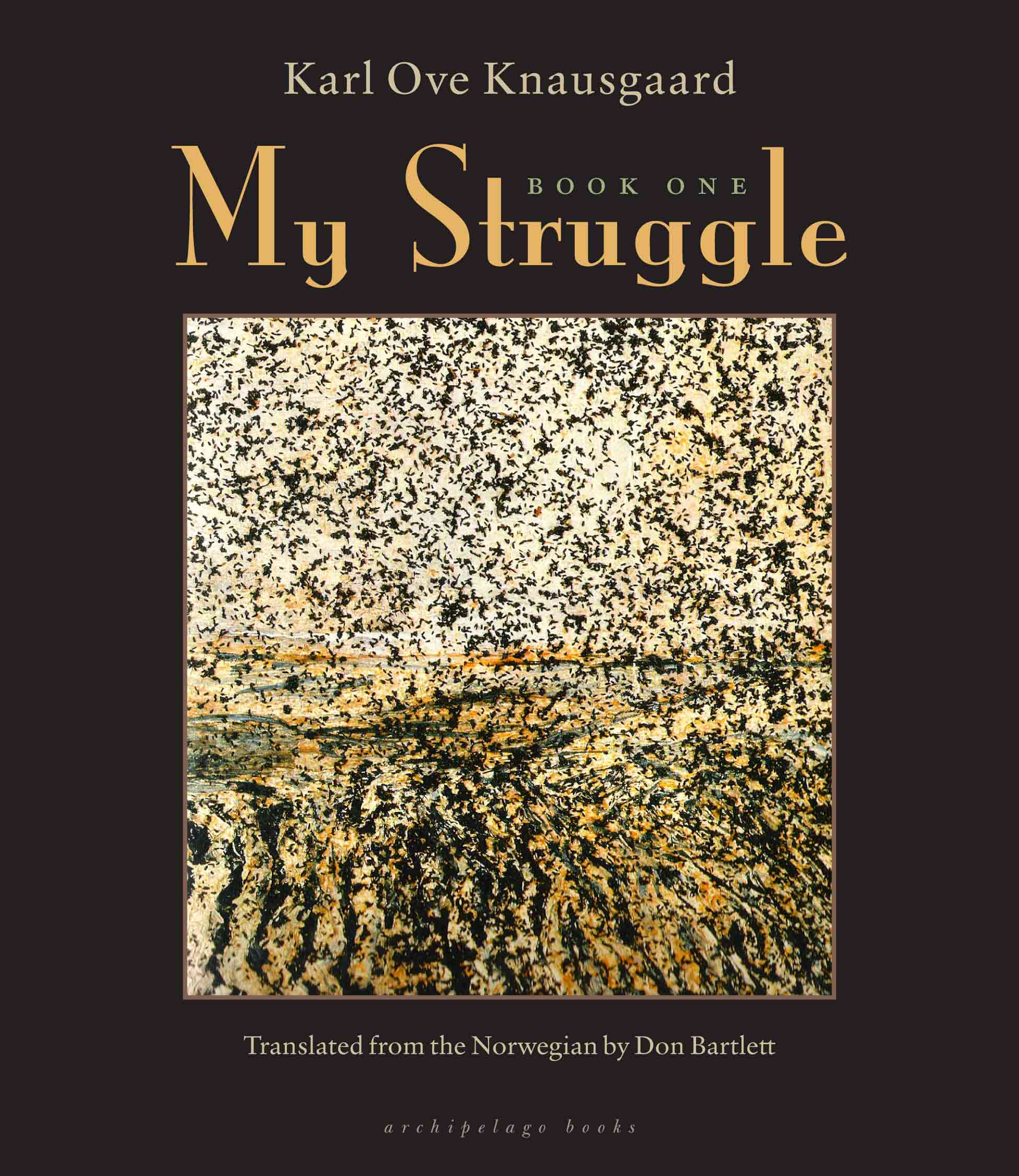
Kickstarter for My Struggle

Cover of My Struggle Book OneEarlier this week I bought the beautiful hardcover of My Struggle: Book 2, A Man in Love. I went to place it on my bookshelf alongside book 1, and that’s when I realized that book 1 was actually missing. I think I loaned to a friend right before he disappeared, reappearing weeks later in Mississippi where he presumably will be indefinitely. Now A Man in Love sits alone, glorious and thick, but proud. Maybe too proud to share the shelf space with a paperback companion anyway. 

Luckily, it may have a companion soon, if Archipelago’s Kickstarter succeeds. They’re seeking to release a hardcover of Karl Ove Knausgaard’s My Struggle: Book 1 next year. Currently they’re about $2500 short, so go back them so I can give my man a companion.


A Tale of Two Openings

I’ve been trying to read The Blue Book by A. L. Kennedy, but I’m having trouble working up any enthusiasm for the book. If I could pinpoint the reason, I might feel validated in giving it up, but instead I keep forcing myself to bring it to work with me in case I might feel like reading it during lunch. Finally a friend convinced me that I should not be so slavishly loyal that I don’t read at all, so I picked up some books on a whim and have been alternating between them and The Blue Book. I sped through two mystery novels this way, then started Ruth Ozeki’s A Tale for the Time Being.

As soon as I opened A Tale for the Time Being (henceforth, ATftTB), I noticed an eerie coincidence. Both ATftTB and The Blue Book begin in the second person. Seeing the word ‘you’ on a page, absent of dialogue, is a strange enough feeling, but to have both of the novels that I’m reading shock me with that word?

Even though both openings have that particular structural similarity, they are otherwise quite different, at least in how I reacted to them. The Blue Book‘s usage of ‘you’ irritated me a bit, while ATftTB drew me in. What was the difference? Even after rereading the first page of each over and again, I am still unsure.

The Blue Book begins:

But here this is, the book you’re reading.

Obviously.

Although I have no describable reason for assuming this, it strikes me as a literary affectation. The book that tells me about the book that I am reading. Except I have a hunch that this book will not be If on a Winter’s Night, a Traveler

Kennedy goes on to describe how I am approaching the book. “…you face it.” So far, yes, I am facing it. Then, “you are so close here that if it were a person you might kiss. That might be unavoidable.” Certainly if a person’s face were nuzzled into my lap as this book is, I would hope they would be someone I would feel comfortable kissing. “You can remember times when kissing has been unavoidable.” Can I? Not really. And even if I could, I certainly wasn’t remembering them until the narrator mentioned it.

This is Kennedy’s tactic; to attempt to put thoughts in my head. It kind of works, in the way not thinking of a pink elephant works. The problem is, I’m not clear why yet I’m being addressed this way, and if it has a point beyond affectation. I am still cautious, suspicious. I have not yet given Kennedy my trust. And here she is, trying to infiltrate my thoughts.

I agree that I did sign up for that when I picked up the novel; such infiltration is the entire purpose of literature. I guess maybe I am just used to books being a bit more circumspect. I would like to get to know someone, after all, before they nuzzle their face into my lap.

ATftTB begins:

Hi!

My name is Nao, and I am a time being. Do you know what a time being is? Well, if you give me a moment, I will tell you.

This book introduced itself, or rather one of its narrators did. I already feel more comfortable with it. Then Nao launches into what a time being is, as promised. Like Kennedy, Ozeki is using a meta book within a book, and drawing attention to her technique, the kind of tricks that tend to make me mutter “MFA” under my breath and sigh. Nao, though, makes it clear to me fairly soon that the technique is not a show, her time being explanations linking the tactic to the works’ themes.

“You wonder about me,” Nao says. I am wondering about her; her observations still align with my thoughts so the fourth wall is reinforced rather than weakened. “I wonder about you.” Nao is suddenly relatable; we are sharing this activity of wondering together. The tiniest emotional connections begin to form (well, strengthen. They formed at that first exclamation point.) I pull back for just a moment before I get sucked in, just long enough to wonder, “how long can Ozeki keep up this conversation before it beings to feel false?” Nao continues, “Are you a male or a female or somewhere in between?…Do you have a cat and is she sitting on your lap? Does her forehead smell like cedar trees and fresh sweet air?”

I’m still not very far into the book, but so I can only give a noncommital answer to my question “how long will this feeling last?” At least 100 pages.

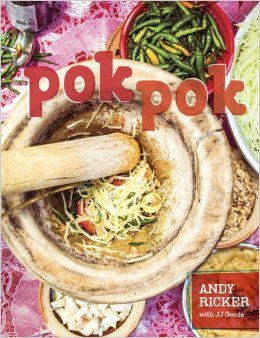
Pok Pok

Pok Pok cover

“Kill the crab.”

So begins one of the recipes in Pok Pok, the cookbook spinoff of Andy Ricker’s eponymous Portland restaurant specializing in Northern Thai cuisine. Ricker doesn’t shy away from the fact that this cookbook is for the committed, for those ready to learn how to kill a crab before dinner. Even if you choose to start with your ingredients already incapacitated, you will still be in for an evening of work. Making your own curry paste is a given since the paste is the central flavoring component of most dishes. Ricker demands more than just making the paste by hand; he describes the two different types of mortar and pestles that you should buy to do so. You will have to track down not only the infamous live crabs, but also blood and banana leaves. Substitutions are frowned upon.

Ricker understands what he is asking, and in the introductory materials he reassures the reader several times that this is necessary. “Some dishes can’t be replicated at home with concessions to convenience,” he warns. If you do adapt the dishes to the point of being unrecognizable, he will sigh, but understand, because he “wouldn’t be upset if it simply helped you make great food at home.” In testing these recipes, I tried to follow the instructions as closely as seemed reasonable. I didn’t go out and buy a mortar and pestle; I used my coffee grinder. My grocer didn’t have fresh Chinese noodles so I settled for dried; which led to extra complication and a small disaster later when I had to separately fry some, but that was my own fault. Even after making adjustments to the recipes to make it easier for me as a home cook, my testing companion and I still found it to be quite a lot of work.

When we sat down to eat our hard earned meal, all our suffering was redeemed. Everything was unbelievably delicious. I don’t think I’ve tested another cookbook where every single dish I tried was “Oh Em Geeeeeee!” good. This became the type of meal where dinner conversation disappears after the first bite and all you can hear is slurping and burping. The Khao Soi Kai, a coconut-based curry from the Ching Mai province, was rich and fragrant. The fried egg salad caused great skepticism as we were preparing it. The proportions of greens and eggs seemed off; the dressing tasted too spicy to eat. When it all came together, it turned out that Ricker was exactly right about everything and we were wrong to doubt. The stir fried water spinach was so delicious we fought over who would have the last serving. The sauce used in that recipe is going to become my default stir fry sauce from here on out. This might have been one of the tastiest dinners I’ve ever cooked in my tiny apartment kitchen.

Going into this book expecting the immersive education experience of a culinary tour guide book like Burma: Rivers of Flavor may lead to disappointment. Ricker editorializes too often, compromises too little. If you approach this cookbook as you might a celebrity chef’s manifesto instead, with a little humility and a lot of determination, you will benefit more from the experience, and the delicious smells of Northern Thailand wafting about your kitchen will be your rewards.

Bookstore in… West Campus?

This has to happen to me??? Fucking bookstores.

Image

Malvern Books: A Literary Community

That’s right, an independent bookstore opens up within bike riding distance of my house just when I decide to start saving money. If there’s a god up in the clouds laughing at me while I shake my fist at him like a 5 foot tall Ralph Kramden, then he’s a sick fuck because why would you mess with readers of all people. Like what have we ever done to make this country worse? Motherfucker.


In all serious… this is so awesome. I just wish I could be there at the grand opening!

More on Isa Does It

If you read my review of Isa Does It earlier this month, then you know that I am super excited about this book. Well, Isa just increased my excitement because now she is giving away a free tote bag with each book. Austin has a no-bag ordinance for grocery stores, so I have turned into a tote bag hoarder. Woohoo!

She’s also posted a recipe from the book, Everyday Pad Thai. I haven’t had a chance to try this one yet, but everything else I’ve tried from the book so far has been tasty and easy.