VeganMofo: The Alternative Vegan

For the month of September, this blog will be devoted to VeganMofo. Tune in while I provide short reviews of some of my favorite, and least favorite, vegan cookbooks. If you are new to Libromancy, please check out some of my non-cookbook reviews, such as my review of Pacific by Tom Drury

9780977080427_p0_v1_s260x420

Alternative Vegan is the type of cookbook that would really be a recipe zine, if passing around recipes zines by hand was still something people did. It’s a 20-something vegan (and restaurant) chef describing the kind of food that he cooks at home at night, like rice and beans, throw-everything-in-the-pot-soup, and roasted potatoes. The only twist is that many of the recipes are not just bachelor food, but Indian bachelor food. The beans and rice here is Venn Pongal and the pickles he presents are Indian pickles. More experienced chefs might not want a cookbook that has a recipe that calls for nothing more than spreading hummus on lavash, but new cooks or cooks working in a constrained space like a dorm might feel relieved to know that there is something that they can make with limited resources.

You can preview many of Dino’s recipes at his blog: Alternative Vegan.

VeganMofo: Vegan Fusion World Cuisine

For the month of September, this blog will be devoted to VeganMofo. Tune in while I provide short reviews of some of my favorite, and least favorite, vegan cookbooks. If you are new to Libromancy, please check out some of my non-cookbook reviews, such as my review of Pacific by Tom Drury

raw vegan sushi rolls

Photography by prideandvegudice on Flickr.

For most of my life, I have not been a fan of raw vegetables. I didn’t even like fruit very much for that matter. I had a healthy plant-based diet for years, but it consisted heavily on roasted vegetables and warm soups. I was tempted by the pseudo-health benefits of a raw diet, but it ended up being the one diet I never tried because I knew that it would be nigh impossible for me. I could probably have given up sugar more easily than give up cooking my food.

When I first visited Blossoming Lotus in Portland, then, it was with a sense of adventure. They had, at the time, a varied menu with the kind of macrobiotic bowls that vegans used to be known for, comfort foods such as bbq tempeh and mac and cheese, and a selection of raw dishes that were unique to Portland. I could finally try a raw dish that was not just a salad, and a professional quality one as well. I had the raw pizza that day: a flax seed and nut crust, topped with a cashew-based cheese, curling strips of zucchini, and other vegetables that were both tender and flavorful. It was delicious. Based on this dish alone, I went out and bought their cookbook, Vegan World Fusion, thinking that it would usher in a dietary Age of Aquarius where I would suddenly want to eat all of the beautiful, healthy dishes my taste buds had previously scorned.

That didn’t necessarily happen, although I am still sure the blame rests with me and not with the book. The book is beautiful and packed with recipes and as varied as their restaurant menu. A raw fettucini alfredo is preceded by a thai salad and two pages before that is an okra masala. I enjoyed all of the recipes that I tried, such as the blue corn crusted tempeh, but the truth is that I actually tried very few of them. Many things in this book were turn-offs for me. Every page is glossy and in color, but most of the photography is of mountains or eastern religious iconography, not of the actual food. The recipe names obscure what is actually being presented; take Serendipity Soba, for instance, which could be more accurately described as a peanut noodle bowl with vegetables, or Mount Sinai Manna Bread, which is a versatile raw loaf recipe based on wheatberries or spelt berries. It made it hard for me to imagine myself preparing and enjoying the food. Instead I was imagining myself on a meditation retreat in Hawaii. Very pleasant, but not what I needed to inspire dietary changes.

Luckily, the restaurant is still flourishing in Portland, so I can enjoy their food for its taste alone, and I don’t even have to clean up afterwards.

Sample recipes:

Southwest Tempeh Chili

Sistah Jah Love Roasted Squash Soup

Conquering Lion Cashew Cheez

Other reviews:

Positive review from Vegan Guinea Pig

Don’t Get Mad Get Vegan tests the Green Goddess Dressing and a tofu scramble

Vegan Cookbook Challenge recreates the live pizza

VeganMofo: The Vegan Stoner Cookbook

For the month of September, this blog will be devoted to VeganMofo. Tune in while I provide short reviews of some of my favorite, and least favorite, vegan cookbooks. If you are new to Libromancy, please check out some of my non-cookbook reviews, such as my review of Pacific by Tom Drury

It seems right that I start VeganMofo with the first vegan cookbook that I’ve reviewed on this blog: The Vegan Stoner Cookbook. VeganMofoers will recognize the name instantly as that of the hugely popular cooking blog of the same name.

The cookbook is not only as cute as the blog, but cuter. Many of the recipes are repeats, but the book is still worth having in your kitchen because you need a cooking reference, so it may as well be one that makes you laugh.

See my full review here: Sprouts Illustrated

Reviews and samples from around the web:
5 Minute Churros at Mr. and Mrs. Vegan
Lentil Loaf at Karmatarian

Vegetarianism for One

Eat Your Vegetables is Joe Yonan’s follow-up to Serve Yourself: Nightly Adventures in Cooking for One. Eat Your Vegetables also focuses on solo-cooking, this time from a vegetarian perspective. Well, not exactly vegetarian; hello, anchovies!

Like many of my favorite cookbooks, EYV is more than just a collection of recipes. This work is more textual than many cookbooks, with small essays mixed in between chapters. I enjoyed the chatter, especially the historical bits and kitchen tips such as how to keep half an avocado fresh in the fridge. Most of these hints are targeted at a solo chef who needs to keep partial ingredients fresh. I still found them enormously helpful even if that doesn’t apply to me; who doesn’t need to know how to creatively reuse leftover ingredients?

I’ve seen reviews for Serve Yourself complaining that this isn’t quick, weeknight cooking like the reviewers expected. Yonan’s book aims to appease the foodie who happens to live by herself and doesn’t have an outlet for her cooking desires. To appreciate this book, you have to not feel silly sitting at home by yourself and enjoying a beautiful sweet potato and mushroom galette that looks like it came from a French bistro. That being said, very few of the recipes are not quick and easy. Some recipes are very basic recipes from the U.S. lexicon, like sloppy vegan joe, made with a meat substitute. Other are closer to foodie fare, such as Socca with Eggplant and Broccoli. Even when he branches into international cuisine, the recipes are very accessible. The most difficult to procure ingredients in the book are chickpea flour and Peppadews.

Peppadew
This is a Peppadew.

I tested two recipes, the Thai Basil Fried Rice and Kale and Caramelized Onions Quesadillas. The fried rice was a very straightforward recipe, not at all different from any other similar fried rice recipe you may have encountered. I found myself changing it drastically to meet my tastes and can’t really comment on the quality of the original recipe except to state that it was obviously very flexible! The quesadillas, on the other hand, I made exactly as described and they were fantastic. They only take about 5 minutes if you have the tortillas and onions on hand (which you will if you follow the encouragement of this book to make time consuming treats like that in advance to store). They were by no means traditional quesadillas, even though I swapped out the mozzarella for Mexican queso fresco, but they were much healthier and still very filling.

I highly recommend this book to cooks who live by themselves or with roommates who are not worth cooking for. You can’t eat microwave lasagna every night.

Women’s magazine quiz…

Is The Conversions by Harry Mathews the book for you? Answer the questions below to find out!

Would you relish stopping in the middle to unravel a page of code?

Can you read French?

Are you sure you don’t suffer from a psychologically unfounded abhorrence to all things Scottish?

Are you such a fan of Oulipo that you want to read a book that even subjects its characters to a constant barrage of Oulipian constraints that they need to overcome?

Do you get a sick pleasure out of reading lists (and does that mean I’m turning you on right now)?

Do you want to know what ‘recrudescence’ means?

Do you enjoy Latin wordplay?

Does metafiction make you sigh with subverted pleasure like a Victorian heroine?

If you answered ‘yes’ to all of these questions, you can borrow my copy, as long as you promise not to get upset about the scrawled “WTF”s that I have all over the margins.

(BTW, Google Books has a preview if you want to sample a chapter.)

Tirza

Cover of Tirza

Tirza by Arnon Grunberg, translated from the Dutch by Sam Garrett (Netherlands; Open Letter Books)

Although I read Tirza (Arnon Grunberg) a few months ago, it still sits on my nightstand. It’s such a beautiful physical object, as all Open Letter Books are, that I am hesitant to move it. I appreciate that their graphic design has a timeless quality because there are some books on my shelf that definitely show their vintage. In some ways, this novel is a psychological thriller, but the artwork is not the titillating or grim imagery of a thriller. Instead it is an elegant plane, representing the plane trip that separates the two distinct portions of the novel.

The first portion concerns a party, a going-away party for the titular Tirza, daughter of Jörgen Hofmeester. Jorgen lives for his daughter; she is the center of his life, his “sun queen”. And she is leaving him, going away to travel across Africa with a boyfriend that Jorgen has never even met. Jorgen wants this party to be perfect for her. This is his last chance to attempt to be the perfect father. He deals with every setback as it comes: his estranged wife returning and behaving maudlinly, Tirza’s professor catching him half-dressed, a classmate who refuses to participate in the dancing. Meanwhile, we are in his head, watching his ego crumble under each further challenge and humiliation.

This was hard for me to get through, this being in Jorgen’s head. I become emotionally worn down by books with unpleasant characters. The only Open Letter book that I didn’t enjoy, Rupert: A Confession, had this problem. But this book was different. Jorgen always managed to pull me back in when I was slipping out of the narrative. He just tries so hard, tries, as he reiterates throughout the novel, to be a better person. This is not just 400 pages spent in an unpleasant location. It’s not watching Sisyphus give it one more go. Instead, the narration is dynamic. It constantly shifted my perspective of Jorgen and of Tirza. New elements of their relationship were constantly being revealed. I wanted to hang in there, to give Jorgen one more chance.

The latter half of the novel occurs after Tirza has left her home for her trip. This portion is more fast-paced, although I notice that some reviewers here on Goodreads disagree. Less time is spent in Jorgen’s head; instead he finally begins to reach outside of himself, to make contact with others. Much of this portion is him verbally trying to explain what happened in the first half. We finally see how he rationalizes his behavior and his thoughts. Although the portions seem radically different, they fit together snugly to give us a more complete analysis of Jorgen.

If you’re curious about if you’d enjoy this work, you can always dive right in. There’s an excerpt found on the publisher’s site.

Paprika: the rapey novel, not the spice

TLDR; conceptually interesting, but those concepts are not realized until the second half. Also, major trigger warning.

Paprika, a novel by prolific Japanese sci-fi author Yasutaka Tsutsui, is about the invention of a device to access others’ dreams. The protagonists and villains are doctors who work on psychological disorders at a cutting-edge clinic. Using the new device, they can watch a patient’s dreams and help diagnose and cure the patient’s neuroses. Of course, someone quickly realizes the power that one could wield with such a tool, as well as the fun sexual uses it could be put to, and thus conflict is introduced.

The book begins when workers at the clinic who had access to the device begin to suddenly go mad. The cause of the madness seems like it is intended to be a mystery, but the writing quickly ruins any suspense. Within a few pages a certain doctor Osanai is behaving so shadily that the reader instantly knows he is responsible for the attacks. The protagonists, meanwhile, wonder about it for another 100 pages or so while the reader has ceased to care. All potential points of interest are dismissed in this fashion. Why is this other fellow acting so villainous? No use wondering for long, because soon someone remembers his entire backstory in one quick paragraph, tidily handing him a motive. When a powerful, new version of the device, the DC Mini, goes missing and the characters urgently need to find it, they muse about where it is but don’t actively search for it. No need; when the time is right one of them just finds it in a pocket where they had placed it and forgotten it.

It’s a shame that a book about the amazing ability to enter another person’s dreams spends over half of its text with mysteries that never have a chance to be mysterious and boring anxieties about who is offending whom in the Japanese workplace. The second half finally indulges in the possibilities the technology offers. Part 2 opens with the history of a strange European sex cult and then launches into a long series of chases through nightmares, with all of the fantasy and physics-defiance that the reader had long been waiting for. The writing is still shoddy, but there is enough distracting action to make it delightful nonetheless.

There is one aspect to the book that I know some would describe as being independent of its literary merits, but which has a significant impact on whether or not I am able to enjoy a book. I know that I am not the only one in this. This aspect is rape. Rape here, rape there, rape everywhere. The rape in this book is unique in that the violence is not the horrifying aspect; rather, it is written such that the main female character, Dr. Atsuko/Paprika, more often than not semi-consents to the rape, as paradoxical as that sounds. In one instance, she even insists that she needs to be raped to save her life. Discussing this with others, we could not decide if literally asking for rape even qualified as rape anymore, but that’s how it is described within the novel. The book devolves into hentai on more occasions than the narrative requires and if I wasn’t reading it for review I would have stopped at the first disgusting ecchi-fanboy moment. And that’s not even getting into the other questionable decisions the author made in regards to how he portrays Dr. Atsuko, such as the fact that despite being a Nobel-nominated scientist, all people care about is her vagina and how she looks.

Despite my reservations about this novel, I know there are several people out there who would enjoy it, like people who read Palhaunik for his edginess. The chase scenes are fun, the science is fantastic, but the book is horribly, horribly flawed.

The Flamethrowers

The Flamethrowers is the story of “Reno” (not her real name) as she tries to go from small town western gal to big city artist. She moves to New York City after graduation from her small art program and lives on her own, imagining all of the excitement that she will have once she finds a crowd and fits in. Eventually she does find that crowd, a crowd that is coincidentally perfect for her. It just so happens that she loves motorcycles and Italian and wants to create land art. She is “discovered” by Sandro Valera, accomplished artist and Italian heir to a motorcycle mogul. Oh, and he has an interest in land art. And an interest in beautiful younger women. He sweeps her into the 70s New York art scene, and later, accidentally into the radical elements of Italy during the country’s Years of Lead. Think the Red Brigade and molotov cocktails that utilize espresso makers.

The plot is at times thrilling, at other times simply heady as you get to peep behind the curtains at late 70s evenings at the Chelsea Hotel, at the kind of games that drunk artsy people play. There are also moving scenes of the American west and a peek into the lifestyles of the rich and famous in Italy. If there’s one thing this novel has it’s enjoyable, if dark, escapist fun.

What I didn’t enjoy, initially, was the narration. The book is mostly told from the first person point of view of Reno, except for a few exceptional chapters primarily told from the point of view of Sandro’s father. Reno’s point of view was full of pithy M.F.A. aphorisms that were far too clever. I only have the experience of my own mind to pull from, but in my experience, my running narration is more like, “Wow, I’m bored. I wonder what’s for dinner. I kind of need to pee. No, I’ll wait until this episode of the West Wing is over.” Beautiful, deep-sounding interior dialogue from characters is one of my pet peeves and this book was strong in that area. Let’s just say I think that next year, this will be a primary candidate for the Tournament of Books.

I got over my problem with the narration as I got deeper into the plot. As she entered Sandro’s alternate universe, she became an observer, giving up herself to simply try to absorb whatever magic these artists had that allowed them to just be so cool. She began relaying more of their dialogue, more physical observations, and I was able to sink in. I began to remember similar good times in my life, I began to let my pet peeves go . But this is when my deeper problem with the narration became evident. I knew everything the narrator thought about everything and I knew the things she loved, but I didn’t know her. I didn’t even know her name. I didn’t know how people thought of her, I didn’t know how she reacts in social situations. She says what the other characters tell her but she does not give response. Is she rude? Talkative? Shy? She presents herself as an emotional blank slate. Usually this is a writerly technique to allow the reader to imprint themselves upon the character and deepen their sympathies. Except it doesn’t work in this case. Reno is so strongly defined by her hobbies and her background. Even her moniker derives directly from one of the elements that makes her unique. It’s hard to slip myself into her leather jacket.

So what we get is a book about political action where the heroine appears to have no political feeling. And maybe she doesn’t and that’s the point. A point I miss because I can only ever see her actions obliquely, so I have to imprint my personality on her, and I could never ever be apathetic. Apathy is a prerequisite in her art crowd. She implies that she is only feigning it, but it is hard to tell because she’s gotten so good.

Despite my complaints herein, I still give the book 4 stars. There is absurdity and humor and warmth. And violence. The moments of violence punctuating the novel are beautifully written and make the diffidence of the narration seem more purposeful. The characters don’t care for the world, but the world keeps asking them to care. With muggings and rape and attack dogs. This dissonance is what makes the novel powerful.

Sprouts Illustrated

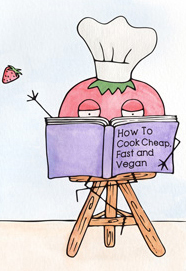
a tomato in a toque reads How to Cook Cheap Fast and Vegan

credit to Sarah Conrique and Graham I. Hayes

The Vegan Stoner is a collection of delightfully illustrated recipes produced by the same folks who run the eponymous blog.

They may call it stoner food but I refer to it as bachelor food. It is the type of thing that I ate when I was living by myself and my silverware drawer was full of plastic cutlery that I had stolen from Starbucks. Or rather, it’s what I wish I ate. At that time I did not have the innate sense of how to create something both tasteful and healthy. The Stoner crew, Sarah Conrique and Graham I. Haynes, not only manage that here with lentil topped baked potatoes and carrot pizza but also manage to do it in 7 sentences or less. It’s a cookbook that can get daily use, the kind you grab when you realize you only have a half empty container of almond milk, ketchup, and 4 items in the cupboard and you’re hungry, now!

Surely, this is a situation stoners often find themselves in, but, let’s be honest, they are by no means the only ones.

A loyal fan of the blog will recognize a few of the recipes here. The published book, however, also treats you to the ganja-fueled adventures of a cohabitating group of vegetables. In each chapter there are a few scenes of bead-wearing mushroom relaxing on a bean bag or a grumpy pear smothering his emotions with food. In addition to learning what my life would be like if all of my friends were sentient produce, I also got a glimpse of something more relevant: how much our culture has progressed into foodieism. I own another cookbook targeted at a similar crowd called the Starving Students Vegetarian Cookbook. You know what type of recipes it includes? Beans on toast. In this one you get a vegan Hollandaise Benedict.

I myself am an unabashed foodie. I realize it is politically problematic, but I can’t deny who I am. And despite its reliance on canned goods and shortcuts, the Vegan Stoner Cookbook is one I would be proud to have in my kitchen. If nothing else, it’s the cutest reference for rice and bean cooking times and water ratios in existence.
———–
More?

You can sample the Zucchini Bean Balls and Baked Banana Cake from their book, as well as their adorable drawings, on their blog.

Even more? Here are some bloggers trying out a few recipes:

The Divine Ms. K. enjoys the VS peanut stew
The Pantry Pocket instagrams the Tempeh Rueben
Painted Whales tries the Lentil Loaf